


Among the priorities set by the CERV call for Networks of Towns, the objective of spreading European and democratic values among rural areas to achieve this concept called «Euromunicipalism» (understood as the empowerment of the European Union in the most rural areas) is framed within «EU citizenship rights».
The reason is that the rights of European citizens are precisely the cornerstone on which all awareness and knowledge activities are built on the value of Europe for young inhabitants of rural areas. Thus, EUmunicipal is a network of 8 European cities, whose starting point is supranational integration as elements of European integration. Therefore, we need to highlight a shared European history that has brought many tragedies and great achievements, which we have built among all European citizenship. The objective of this project is to focus on young people who are members of cultural and sports associations in the municipalities to design activities that promote the exchange of traditions and customs within European culture. The idea is to launch one clear message, the fact that from rural and agricultural areas the message of euroscepticism can be fought and the Euro-municipal chain that coordinates all citizen actions. The main goal is to achieve a great regional impact and make the citizens aware of the importance of reconnecting with the values of Europeanism.
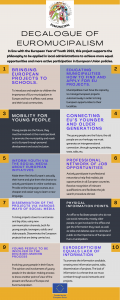
The project is structured around eight international meetings, to discuss anti-Europeanism and the construction of a model that allows young people to relive the European project from cities and municipalities.
One of the fundamental elements to coordinate and reinforce the cohesion of the participants in the project, is the creation of a work team called; Commission European Municipalities (CEM). This centralized organization in the coordination of the project will allow a better implementation and efficiency in carrying out activities in each territory. Each person who has collaborated indirectly and directly in the CEM will be recognized with the delivery of a card as voluntary ambassadors of the values of Europeanism.
The political attitudes and visions acquired in the time that the project is developed, will be based on the wide knowledge of the European institutions from their municipality and on knowing how to contrast the information through the regional press. Also, to be able to contrast the opportunities that are generated through the alliance between municipalities. Where a final document will be drawn up, which will be called the EUmunicipal declaration to value the importance of the cohesion of the local to the heart of Europe.
Bearing all these ideas in mind, the general objectives of EUmunicipal are:
Rafelguaraf is a small town of about 2500 inhabitants, but socially it is a town with a lot of social dynamism and a very active associative fabric in all cultural activities. One of its potential as a municipality is the landscape and agricultural land that has a large area throughout the municipality.
Rafelguaraf is a municipality that has all the necessary basic services, with a wide variety of local commerce and a very active cultural agenda.the most representative associative elements of the municipality are the music school of the municipality, which is called «Ateneo Musical Rafelguaraf» and the municipal school of soccer, the «Club Deportiu Rafelguaraf». These two associations are the most representative socially and culturally throughout the municipality, where most of the young people of the municipality are located.
Considering the region where the association is registered and they are operating in, which is the poorest region in European Union, the young people are in need to develop the skills and the competencies the organizations and the project will allow them. The lack of understanding and not being an active citizenship, to be aware of local governance, policies and the importance of civic participation.
The organization is focused on development of the young people especially in our region and to develop them as active citizens and to promote the European culture. The rural areas are challenging themselves to reach young people, but we have already established partnerships with local authorities, municipalities and schools which will allow us to reach them out easily. The project will allow the young people to be more aware of the project-related topics and to be more proactive as citizens of Europe. The most important is that the association is working in the poorest region in the European Union which has the greatest need for development and all of the young people are with fewer opportunities and limited due to the geographical, economical and social obstacles. Most if not all of the participants involved will be with fewer opportunities and will be in need of developing skills and competencies that will help their development in the future and will allow them to be more active citizens and to be able to find a suitable place for them for the future.
Also the organization’s added value is that we are focused on solving important social challenges that are surrounding us now and they are directly linked with the priorities of European Union.
The study and valorisation of the figure and era of Charles V, the last Emperor of Europe, is key in the development and construction of European history, and necessary when fostering the creation of a European identity and an enduring feeling of shared belonging to an extensive, diverse and supportive common heritage such as Europe that will allow the process of European construction to progress on two of its strongest pillars: culture and solidarity amongst the peoples of Europe.
On the other hand, the organisation will held a meeting of the project of this network of towns. In this sense, they will make sure that in each event, volunteers will be comfortable and have all the resources they will need easily. The Cooperation Network of the European Routes of Emperor Charles V is eager to show EU young citizens how history is a powerful tool to unite EU multicultural citizenship.
The partner has a very positive experience in the participation and management of European projects, recently the Network has participated in Erasmus +, Creative Europe and Europe For Citizens projects.
Hellenic Institute of Cultural Diplomacy Netherlands (HICD NL) is a scientific non-governmental organization which General Committee is formed by local development stakeholders and specialists from various sectors of the civil society and European Member States: academics, NGOs, development agents, association managers, civil servants and social economy companies, as well as European organizations for local development.
HICD NL operates as a social player in collaboration with local and regional organizations and institutions in the fields of Culture, Environment, Entrepreneurship, Equality (Gender Equality), Cultural Diplomacy, Education through New Technologies activities. Specifically, it provides Non-formal/ Vocational education, ICT education and innovative educational activities Integration of educational solutions into mainstream curricula specialized education for specific groups. It counts on the support of the Municipality of Rotterdam (Netherlands) and it will represent this city in the project, organizing the international event in Rotterdam and sending representatives of the city to the rest of meetings.
The Hellenic Institute of Cultural Diplomacy Netherlands is a well experienced entity that, counts on a long experience dealing with EU projects. It will actively contribute to all project activities and results. It will organize the Sixth international event, “Social integration as the backbone of European society”,involving local associations and youngsters. It will also send delegations of participants to the rest of international events. The Hellenic Institute of Cultural Diplomacy Netherlands will also contribute actively to project dissemination and impact.
Karcag is the largest border settlement and the fourth most populous city in the county. Due to its location, cultural, commercial, health, educational and economic role, the settlement has became the center of the landscape. The town has a population of 19.000.
The tender activity of the municipality is outstanding. Investments of billions will be realized. The Elisabeth Grove and its surroundings will become a complex sport and leisure centre. Young and elderly alike will find recreational activities to suit them, including the existing Lombkorona promenade, Kosárliget track, Pump track, Akácliget Spa and Bath, Zádor Bridge, Kecskeri Lake.
There is a diverse cultural life in the city. In addition to the exhibitions of the Györffy István Nagykun Museum, the Kántor Sándor Pottery House and the Nagykunság Country House, the color programs of the Déryné Cultural, Tourist Sports Center and Library are also attractive
The characteristic traditions of the landscape are the Kun embroidery, the lace and Hungarikum Karcag Mutton Stew making. Worthy descendants of the 19th century carvers today carve beautiful folk furniture, sculptures, make gate posts, fences.
Those interested in local gastronomy can also taste the Karcag mutton stew, the famous ferdinand of Karcag and millet dishes and pastries.
Among the numerous cultural events, the annual Karcag Sausage, House Pálinka Competition and Homemade Dough Pasta Cakes Competition, the Karcag Mutton Stew Cooking Festival, the Nagykunság Cultural Days, the Tractor Competition and the Day of the Town are highlighted.
For Karcag it is important to reduce emigration, which can be achieved by creating new jobs, as well as by developing social and health care, education and infrastructure.
Genista Foundation had been set up in 2002 and has 12 youth workers and several teachers who give their time in youth work, organizing training, workshops, lectures, hands-on activities, etc. GRF works with children, youths and adults, focusing on empowering, educating and giving opportunities to people with educational, social, minorities and refugees through its dedicated team of youth workers all qualified with university degrees.
GRF regularly organizes local and national training events, workshops and seminars. It also provides this service to other NGO’s and local councils, with professional staff experienced and qualified in the subject. Our directors and staff also provide the services of economic reports, scientific studies, cost-benefit analysis, training and mentoring services. Through the years GRF has coordinated and participated in several projects focusing on the use of non-formal methodologies focusing on using practical media and communication tools as a means to empower disadvantaged youths and females in projects in Palestine, Turkey, Slovakia, Malta and Spain where disadvantaged participants which also included young immigrants were allowed to bring out their creativity and hidden assets through active participation in the workshops and activities organized.
The Amarante Municipality is located in the Northern Region of Portugal, belongs to the sub-region of Tâmega and Sousa, covers an area of 301.3 km2 and is made up of 26 parishes.It is the municipality with the largest geographical area of the District of Porto and the one of the highest population of the NUT III – Tâmega e Sousa.
In the last years, there has been a greater «urbanization» and an emptying of rural spaces, which has materialized through exodus and depopulation, and the municipality presents an absence of a transport and accessibility policy articulated with the daily necessities of the population.
The Municipality of Amarante already has vast experience of participation and execution of applications to European funds of different types, both infrastructural and immaterial. This executive believes that it is possible to learn from the best examples and has established relationships with different partners to involve all local and regional players. A sign of this commitment was the creation of the APE team, a structure created by the municipality of Amarante with the objective of boosting private investment, supporting the business fabric, promoting entrepreneurship, tourism and innovation in the region. This structure aims to make investment more attractive by simplifying the processes involved, integrating into the regional and national economic network and a set of incentives and support in this regard. With this team it has already been possible to participate in two URBACT projects and to be currently involved in another 3 international applications. For this purpose, the team was structured with the most diverse values, as it is possible to verify by the profile of the technicians involved, reinforcing itself whenever necessary in the deficit areas.
Scout Society association has been established in 2011. The purpose of the organization is to encourage volunteering and to contribute at the development of the local community, especially in the process of youth education via non-formal education activities.
From the desire of helping young people to grow both personally and professionally, but also to involve them in society and local communities which they came from, the association began to develop its activity field, making projects with various themes( like sport, health, multiculturalism, tolerance towards others, discrimination, increasing employability, career orientation), but keeping the same purpose since its establishment – helping young people in their development and form as individuals involved in society, which preserve and share with others European values( unity, communication, tolerance, solidarity, respect, equality, communication, pluralism, peace, democracy, liberty).
In the last years, the association developed significative international cooperation, currently having partnerships with organizations from Croatia, Czech Republic, Spain, Slovenia, Bulgaria, Hungary, Poland, Turkey, Lithuania) and had carried out a significant number of projects and volunteering activities, youth exchanges, strategically partnerships which involved over 2000 young people from different communities in Romania.